After My Claude Code Account Was Banned, I Fixed My Exit IP
My Claude account was banned a while ago, and Claude Code stopped working with it. Anthropic does not say which rule was triggered, and appeals rarely come with a detailed explanation. After registering again, I started treating the network exit as part of the setup.
The short version: a single, clean residential IP matters more than constantly switching nodes.
Bans rarely have one cause
Common triggers include:
- an IP that jumps between countries or regions
- datacenter IPs, free proxies, or shared exits
- a payment method that does not match the account region
- bursts of requests, or one account shared across devices or people
Anthropic does not explain individual cases, so the practical move is to keep every controllable variable stable.
The setup I use now
- A fixed residential IP: a static proxy from webshare.io, around $1.5 per month. That is enough for one person using Claude Code. Pick a fixed endpoint, not a rotating IP.
- Payment: subscribe to Claude Pro through Google Play on Android. Compared with virtual cards, in-app billing is more stable and easier to keep consistent with the account region.
- A two-hop proxy: in Clash Verge, go through an airport first, then use the webshare HTTP proxy as the exit. TUN must be enabled.
Why two hops
Connecting directly to webshare has two problems: the route from where I am may be unreliable, and my home IP is exposed to the proxy provider. With the airport hop:
local → airport (fastest node) → webshare (fixed residential IP) → Claude
The airport gets you out; webshare provides a clean, fixed exit. The target sees the webshare IP, not the airport or your home connection.
One caveat: the airport can still see destination domains and traffic metadata, so it has to be trusted. This chain fixes exit IP reputation; it is not anonymity.
Clash Verge configuration
-
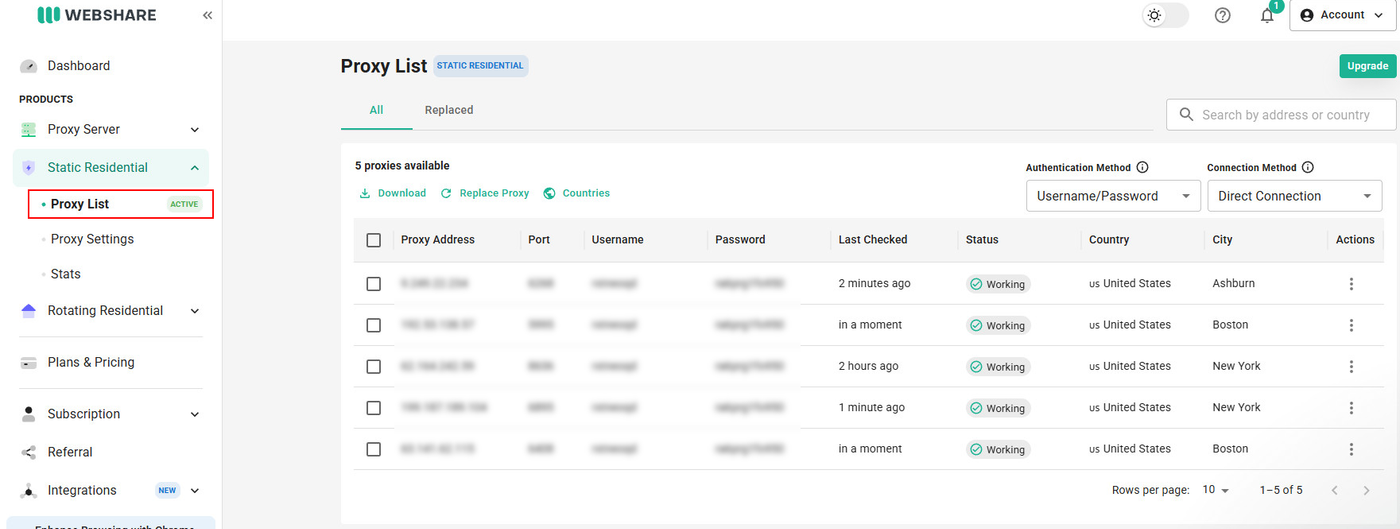
Create a static proxy in the webshare dashboard and note the host, port, username, and password.
-
In Clash Verge Rev: Subscriptions → Global Extension Script, open it, and paste the script below. It applies globally.

-
Replace the webshare endpoint values at the top of the script, then uncomment the username/password fields in the node.
-
Make sure the airport subscription has a group such as “Auto Select” or “URL Test”.
-
Enable TUN. Claude Code is a CLI program and does not read the system proxy settings; without TUN it may not use the proxy at all.
-
Verify with
curl https://ipinfo.io/json— the IP should be the webshare endpoint.
What the script does
The global override works in six steps:
- Finds the airport's auto-select group to use as the second hop.
- Creates HTTP proxy nodes for the webshare endpoints and sets
dialer-proxyon each one to that group. This is the “airport → webshare” chain. - Adds a
🔒 Clean IPselect group containing the webshare nodes, defaulting to the first one. - Rewrites rules: keeps DIRECT / REJECT / PASS rules, points every other proxy rule at the exit group, and drops the original MATCH / FINAL rules.
- Appends two fallbacks:
GEOIP,CN,DIRECT,no-resolvefor domestic IPs, andMATCH,🔒 Clean IPfor everything else. - Handles name collisions and logs a short diagnostic.
HONOR_PROFILElimits injection to a named profile.
Caveats
- This lowers the probability of a ban; it does not guarantee anything. Account behavior, payment, and usage patterns matter too.
- Keep one account on one exit. Do not switch from the US to Japan and back.
- webshare credentials sit in the script as plain text. Never share a config containing them, and rotate the password if it leaks.
- Do not switch between airport nodes and webshare endpoints constantly; the exit group only selects the first node by default.
- This is a personal setup, not advice on bypassing the terms of service. Anthropic's enforcement rules are the authority.
The full script (credentials removed)
function main(config, profileName) {

  /* ======================= User configuration ======================= */

  // Names of the airport's auto-select groups, in priority order
  var AUTO_CANDIDATES = ["Auto Select", "URL Test", "url-test", "Proxy", "PROXY", "Node Select"];

  // webshare endpoints [IP, port]
  var WS_ENDPOINTS = [
    ["YOUR_ENDPOINT_IP", 6000],
    ["YOUR_ENDPOINT_IP", 6001]
  ];

  var EXIT_GROUP = "🔒 Clean IP";       // exit group name
  var WS_NODE_PREFIX = "🇺🇸 Clean IP-"; // prefix for generated nodes
  var HONOR_PROFILE = false;            // true = only inject for a matching profile

  /* ====================== End user configuration ==================== */

  config = config || {};
  var groups = config["proxy-groups"] = config["proxy-groups"] || [];
  var proxies = config.proxies = config.proxies || [];
  var rules = config.rules = config.rules || [];

  // 0. Optional: filter by subscription name
  if (HONOR_PROFILE) {
    if (!profileName || String(profileName).indexOf("YOUR_PROFILE_KEYWORD") === -1) {
      return config;
    }
  }

  // 1. Find the airport's auto-select group as the second hop
  var autoGroupName = null;
  for (var a = 0; a < AUTO_CANDIDATES.length; a++) {
    var cand = AUTO_CANDIDATES[a];
    for (var g = 0; g < groups.length; g++) {
      if (groups[g].name === cand) { autoGroupName = cand; break; }
    }
    if (autoGroupName) break;
  }

  // 2. Avoid name collisions
  var taken = {};
  proxies.forEach(function (p) { taken[p && p.name] = true; });
  groups.forEach(function (gr) { taken[gr && gr.name] = true; });
  function uniq(base) {
    var n = base, i = 1;
    while (taken[n]) { n = base + "·" + i; i++; }
    taken[n] = true;
    return n;
  }

  // 3. Create webshare exit nodes, dialed through the airport's fastest node
  var wsNames = [];
  WS_ENDPOINTS.forEach(function (ep, idx) {
    var rawPort = parseInt(String(ep[1]).replace(/[^0-9]/g, ""), 10);
    var node = {
      name: uniq(WS_NODE_PREFIX + (idx + 1)),
      type: "http",
      server: ep[0],
      port: rawPort,
      // webshare requires authentication: uncomment and fill in your credentials
      // username: "YOUR_USERNAME",
      // password: "YOUR_PASSWORD",
      udp: false
    };
    if (autoGroupName) { node["dialer-proxy"] = autoGroupName; }
    wsNames.push(node.name);
    proxies.push(node);
  });

  // 4. Exit group: select, first node by default
  var exitGroupName = uniq(EXIT_GROUP);
  groups.push({
    name: exitGroupName,
    type: "select",
    proxies: wsNames
  });

  // 5. Rewrite rules: keep direct/block, send everything else to the exit group
  var DIRECT_TARGETS = { "DIRECT": 1, "REJECT": 1, "REJECT-DROP": 1, "PASS": 1 };
  var kept = [];
  for (var r = 0; r < rules.length; r++) {
    var t = String(rules[r]).trim();
    if (!t) continue;
    var parts = t.split(",");
    var type = String(parts[0] || "").toUpperCase();
    if (type === "MATCH" || type === "FINAL") continue;

    var last = String(parts[parts.length - 1] || "").trim();
    if (DIRECT_TARGETS[last]) { kept.push(t); continue; }

    parts[parts.length - 1] = exitGroupName;
    kept.push(parts.join(","));
  }
  kept.push("GEOIP,CN,DIRECT,no-resolve");
  kept.push("MATCH," + exitGroupName);
  config.rules = kept;

  // 6. Diagnostics
  try {
    if (!autoGroupName) {
      console.log("[chain] No auto-select group found; webshare will dial directly. Candidates=" +
        AUTO_CANDIDATES.join("/"));
    } else {
      console.log("[chain] second hop=" + autoGroupName + ", exit group=" + exitGroupName +
        ", nodes=" + wsNames.length);
    }
  } catch (e) { /* some engines have no console */ }

  return config;
}